
Window Performance Classes Explained
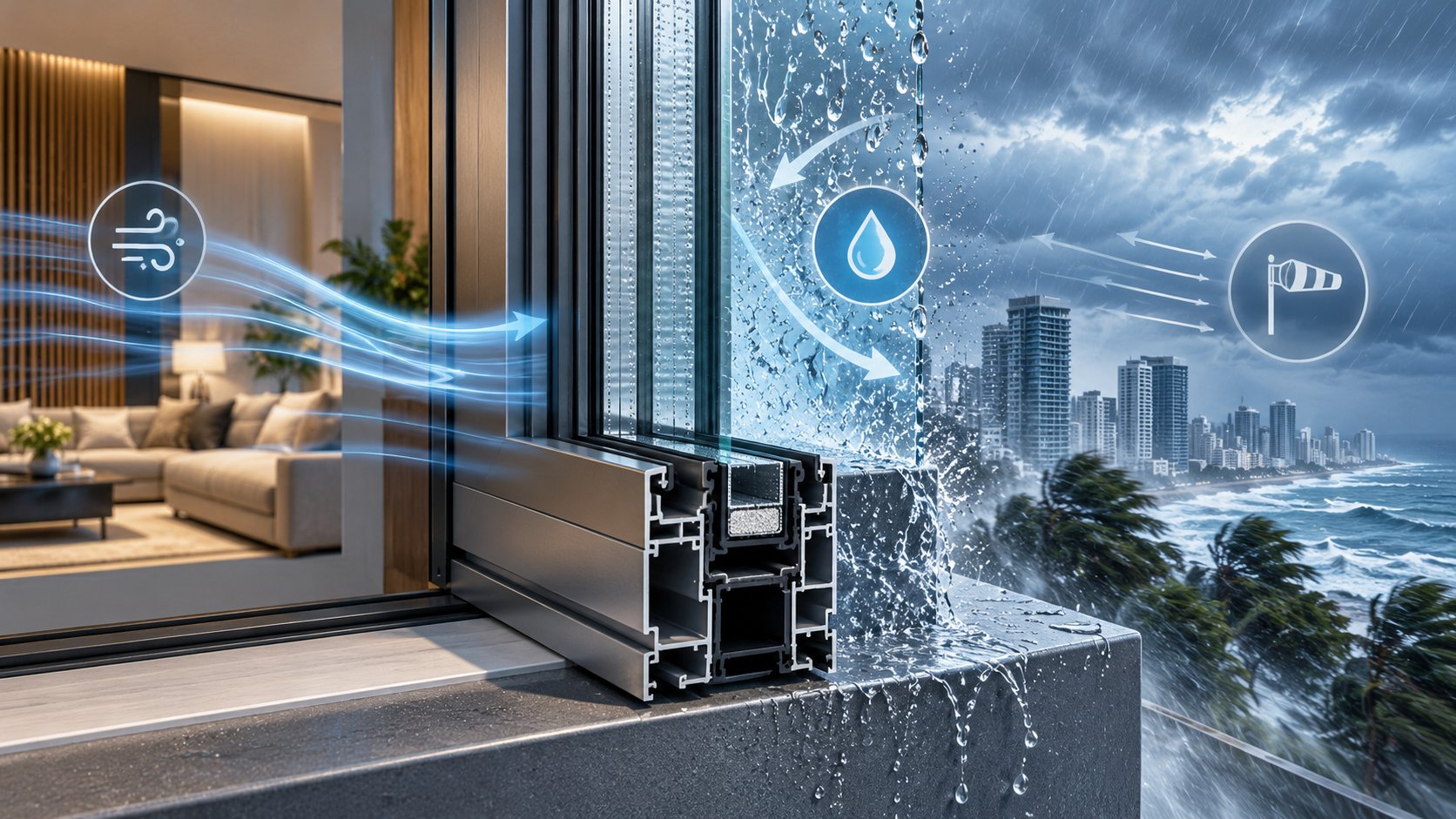
A window might look perfectly solid, yet start leaking when heavy rain and strong wind arrive together. Another may keep water out but allow enough air through its seals to create uncomfortable drafts. And a window that performs well in a sheltered house may face entirely different demands on the upper floors of a high-rise building.
That’s why window performance classes matter. European standards EN 12207, EN 12208, and EN 12210 establish how windows are classified for air permeability, water tightness, and resistance to wind load. Each rating addresses a different aspect of performance, based on defined laboratory tests.
For architects, contractors, developers, and property owners, these classifications make technical comparisons more meaningful. They also help answer a practical question: what level of performance does this particular building actually need?
What Are Window Performance Classes?
Window performance classes describe how a tested window or external pedestrian door performs under specified conditions. They give designers and buyers a common technical reference when comparing products, rather than relying entirely on marketing descriptions or general claims about durability.
In Europe, EN 14351-1 provides the relevant product-standard framework for declaring applicable performance characteristics of windows and external pedestrian doors. Individual properties are then assessed through separate testing and classification standards.
Three characteristics deserve particular attention when evaluating weather resistance:
- Air permeability: The amount of air that passes through a closed window when a pressure difference exists between its two sides.
- Water tightness: The window’s ability to prevent water penetration during controlled water-spray and pressure testing.
- Resistance to wind load: How the window responds structurally when exposed to positive and negative wind pressures.
These ratings shouldn’t be treated as interchangeable. A window can have excellent air tightness without achieving an equally high water tightness classification. A frame may also resist substantial wind pressure while offering less protection against wind-driven rain than another system.
When comparing window performance ratings, the complete set of results tells you far more than a single impressive classification. Specimen dimensions, opening configurations, and test conditions also need to match the proposed application closely enough for the comparison to be useful.
Air Permeability Classes Explained (EN 12207)
Air permeability is the measured amount of air passing through a closed window or door under a pressure difference. EN 12207 classifies that leakage using results obtained through standardized testing.
Uncontrolled airflow can make a room feel drafty, increase unwanted heat exchange, and complicate efforts to maintain comfortable indoor temperatures. Reducing leakage helps address those problems, although an airtight window doesn’t replace the need for proper building ventilation.
What Do Air Permeability Classes 1–4 Mean?
EN 12207 defines four numbered air permeability classes. Class 1 allows the greatest leakage within the classification system. Class 4 has the strictest limits.
| Air Permeability Class | Maximum Leakage at 100 Pa, per m² | Maximum Leakage at 100 Pa, per m of Joint |
|---|---|---|
| Class 1 | 50 m³/(h·m²) | 12.50 m³/(h·m) |
| Class 2 | 27 m³/(h·m²) | 6.75 m³/(h·m) |
| Class 3 | 9 m³/(h·m²) | 2.25 m³/(h·m) |
| Class 4 | 3 m³/(h·m²) | 0.75 m³/(h·m) |
The figures show reference leakage limits at 100 Pa. They aren’t the only measurements considered during classification. The applicable requirements across the prescribed pressure range must also be satisfied, including the relevant area-based and opening-joint-length-based criteria.
Consider the difference between Class 2 and Class 4. Under comparable standardized conditions, a Class 4 window permits substantially less air to pass through the closed assembly. That difference can matter in energy-conscious buildings, exposed locations, and spaces where occupants are particularly sensitive to drafts.
Still, Class 4 isn’t automatically a requirement for every project. A building’s energy strategy, exposure, ventilation arrangements, and applicable regulations should determine how demanding the air permeability specification needs to be.
How Is Window Air Tightness Tested?
EN 1026 sets out the air permeability test method. The window specimen is mounted in a test chamber and closed in its intended operating configuration. Controlled pressure differences are then applied, and the airflow through the specimen is measured.
Measurements are taken at prescribed pressure stages. Depending on the evaluation, the results are expressed relative to the specimen’s overall area or the length of its opening joints.
You’ll commonly encounter two units in a window air tightness test report:
- m³/(h·m²): Cubic meters of air passing through the specimen per hour, divided by its overall area.
- m³/(h·m): Cubic meters of air passing through the specimen per hour, divided by the length of its opening joints.
Testing may cover positive and negative pressure differences. The final EN 12207 classification follows the applicable evaluation rules rather than depending on one isolated reading.
There’s also a distinction between laboratory performance and performance after installation. A rating applies to the tested specimen and configurations covered by the results. If the installed frame is distorted, seals are damaged, or incompatible hardware is used, the finished window may not perform as expected.
Water Tightness Classes Explained (EN 12208)
Water tightness concerns a window’s resistance to water penetration when rain exposure is simulated under controlled conditions. EN 12208 provides the classification system, using test results obtained according to EN 1027.
It’s tempting to judge water resistance by the quality of the visible rubber seals. In practice, there’s much more going on inside the assembly. Profile geometry, glazing interfaces, drainage paths, joints, and installation details all affect where water travels and whether it reaches the interior.
What Do Water Tightness Classes 1A–9A Mean?
EN 12208 distinguishes between two test methods. Method A is intended for products exposed without protection, while Method B applies to products that are partially protected.
The letters A and B identify the exposure arrangement used during testing. They don’t represent different grades of aluminum, glass, or manufacturing quality.
| Class | Test Pressure | Interpretation |
|---|---|---|
| 1A / 1B | 0 Pa | Water penetration resistance at zero pressure difference |
| 2A / 2B | 50 Pa | Resistance at 50 Pa |
| 3A / 3B | 100 Pa | Resistance at 100 Pa |
| 4A / 4B | 150 Pa | Resistance at 150 Pa |
| 5A / 5B | 200 Pa | Resistance at 200 Pa |
| 6A / 6B | 250 Pa | Resistance at 250 Pa |
| 7A / 7B | 300 Pa | Resistance at 300 Pa |
| 8A | 450 Pa | Resistance at 450 Pa |
| 9A | 600 Pa | Resistance at 600 Pa |
| E750 | 750 Pa | Exceptional classification at 750 Pa |
Under Method B, the numbered classes end at 7B. Method A extends to 9A, corresponding to 600 Pa. When a product achieves a qualifying pressure above that level, the classification uses an E designation followed by the pressure value.
For instance, a window rated 9A has demonstrated resistance to water penetration through the relevant stages up to 600 Pa under Method A. An E750 rating identifies a higher declared test pressure of 750 Pa.
Neither classification should be read as a promise that water can never enter the building. Actual conditions vary with rainfall intensity, wind direction, façade geometry, and installation. The laboratory result establishes what happened under a particular set of controlled conditions.
How Is Water Tightness Tested?
During an EN 1027 test, water is sprayed onto the exterior face of the window while prescribed pressure differences are applied. The pressure increases in defined stages, with the specimen monitored for water penetration.
The resulting classification indicates the resistance achieved under those conditions. It doesn’t translate directly into a certain number of millimeters of natural rainfall, since real storms involve variables that laboratory testing deliberately controls.
Window design can also involve managing water rather than excluding every drop from every external chamber. Some systems allow incidental water to enter designated drainage zones, then channel it safely back outside through controlled outlets.
That approach depends on unobstructed drainage channels, properly fitted gaskets, and sound perimeter installation. Construction debris in an outlet or a poorly sealed joint can interfere with the system even when the original window passed its laboratory test.
Wind Resistance Classes Explained (EN 12210)
Wind doesn’t simply push against a window. Depending on the airflow around a building, it can also create suction that pulls the assembly outward. EN 12210 classifies how windows resist these pressures, while EN 12211 establishes the test procedure.
The assessment considers structural response, deformation, and the ability to withstand prescribed loading without unacceptable damage. This is particularly relevant for exposed façades, larger glazed openings, and buildings subject to substantial wind actions.
What Do Wind Resistance Classes A, B and C Mean?
An EN 12210 designation combines two pieces of information: a wind-pressure class and a relative frontal deflection class. That’s why ratings appear as combinations such as A3, B4, or C5.
The number identifies the pressure classification. The letter tells you which deflection limit applies.
| Pressure Class | Reference Test Pressure P1 |
|---|---|
| Class 1 | 400 Pa |
| Class 2 | 800 Pa |
| Class 3 | 1,200 Pa |
| Class 4 | 1,600 Pa |
| Class 5 | 2,000 Pa |
| Class E | Pressure above Class 5, stated explicitly |
These figures refer to the P1 pressure level used within the standardized procedure. Other stages assess repeated loading and safety pressure. A P1 value shouldn’t be mistaken for a universal design wind load that can be applied to any building.
| Deflection Class | Maximum Relative Frontal Deflection |
|---|---|
| A | 1/150 |
| B | 1/200 |
| C | 1/300 |
Take Class C5 as an example. The number 5 corresponds to a P1 reference pressure of 2,000 Pa, while the letter C indicates the stricter relative frontal deflection limit of 1/300. The allowable movement of a particular frame member depends on its relevant span and the test requirements.
Class C is more restrictive in terms of deflection than Class B. That doesn’t establish that every C-rated product is structurally superior in all respects. The complete results still need to be reviewed, especially when comparing windows with different dimensions or configurations.
How Is Wind Load Resistance Tested?
Under EN 12211, the test specimen is subjected to controlled positive and negative pressures. The procedure examines its behavior under structural loading, repeated pressure cycles, and the applicable safety-pressure stage.
Frame deflection is measured, and the assembly is inspected for the effects of loading. Several construction details can influence what the test reveals:
- Profile geometry, wall thickness, and reinforcement arrangements.
- Window dimensions and unsupported frame spans.
- Glass thickness, composition, and glazing support.
- Mechanical connections, locking points, and hardware.
- Structural anchoring and installation requirements.
Window size is especially relevant. A frame that performs satisfactorily at one width and height may respond differently when the opening becomes substantially larger, even if the same profile family is used.
Before specifying a system, designers should establish the project’s wind actions using the applicable structural design framework. In relevant European projects, this may involve EN 1991-1-4 and its National Annex. The proposed window’s classification and covered dimensions can then be checked against those requirements.
Air, Water and Wind Resistance: Key Differences
Imagine a closed window during a storm. Air may find its way through small gaps around the sash. Rainwater may be driven against glazing joints and drainage details. At the same time, pressure is pushing or pulling on the frame and glass.
Each of those effects is assessed differently. Air permeability measures leakage, water tightness evaluates resistance to penetration, and wind load resistance deals with the assembly’s structural response.
| Performance Property | Classification Standard | Test Standard | Main Purpose |
|---|---|---|---|
| Air permeability | EN 12207 | EN 1026 | Control air leakage |
| Water tightness | EN 12208 | EN 1027 | Resist water penetration |
| Wind load resistance | EN 12210 | EN 12211 | Evaluate structural response to wind pressure |
A hypothetical window rated Class 4 for air permeability, 9A for water tightness, and C5 for wind resistance has three distinct performance declarations. Together, those results provide a clearer technical picture than any one classification would on its own.
Even then, the ratings need context. What size was the tested specimen? Was it a fixed window or an operable sash? Which glazing and hardware were fitted? Does the proposed installation fall within the configurations covered by the results?
Thermal insulation, sound reduction, impact resistance, and security are separate performance characteristics as well. Strong air, water, and wind ratings don’t establish compliance with requirements in those areas.
How to Choose the Right Window Performance Class
Start with the building, not the product catalog. A sheltered residential opening and a large window on an exposed upper floor won’t necessarily need the same performance specifications.
The objective is to meet the project’s technical requirements with an appropriate margin, without paying for classifications that offer little practical benefit in that application. Location, building height, exposure, opening dimensions, and local regulations all shape that decision.
Windows for Coastal and High-Wind Areas
Coastal buildings can face a difficult combination of wind-driven rain, humidity, airborne salts, and substantial wind pressure. Water tightness and resistance to wind load deserve close attention in these conditions.
The required classifications depend on the actual exposure. A protected opening beneath a deep overhang may experience different conditions from an unshielded window on the same building.
Corrosion resistance must be assessed separately. A window that performs well under EN 12208 testing hasn’t necessarily demonstrated that its finish or hardware will withstand long-term exposure to salt-laden air.
For coastal projects, examine the full specification: surface treatment, hardware materials, drainage arrangements, weather seals, and maintenance requirements. A strong laboratory rating is valuable, but it doesn’t replace appropriate material selection.
Windows for High-Rise Buildings
Wind pressures can be particularly demanding on high-rise façades. Building corners, exposed elevations, and areas where airflow accelerates around the structure may experience conditions that differ considerably from those at ground level.
Height matters, but it isn’t the only variable. Terrain, local wind climate, building shape, and façade position all affect the design pressures.
The sensible sequence is to establish the required wind actions first, then check whether the proposed window system can satisfy them. Test reports should cover the intended dimensions and configuration, or provide an applicable basis for extending the results.
Large glazed openings need careful coordination between the glass, frame, supports, and anchorage. Treating the window’s published classification as a substitute for project-specific structural assessment can leave important details unresolved.
Windows for Residential and Commercial Buildings
In residential buildings, occupants often notice performance problems through drafts, water leakage, or difficulty maintaining comfortable indoor temperatures. Commercial projects may add larger openings, frequent operation, and more complicated façade requirements.
Opening type also deserves attention. Fixed, hinged, and sliding windows use different arrangements for sealing, drainage, and hardware. Their performance shouldn’t be judged from the operating mechanism alone.
Where wide glazing areas and space-efficient operation are priorities, aluminum sliding windows are worth considering alongside hinged alternatives. The deciding factors should include the actual performance declarations for the proposed configuration, not assumptions about how sliding systems generally behave.
Compare the documented air permeability, water tightness, and wind resistance results of the shortlisted products. A suitable opening mechanism is only part of the decision.
How Aluminum Window Systems Achieve Better Performance
Aluminum allows manufacturers to develop window profiles with different geometries, finishes, and opening arrangements. That flexibility is useful, but aluminum alone doesn’t determine whether a window achieves a particular weather-resistance class.
The complete assembly matters. Seals, glazing, joints, drainage channels, hardware, and fabrication quality all influence the result.
Profile Design and Structural Stability
Profile geometry affects how a window frame responds to loading. Internal chambers, reinforcement arrangements, connection details, and overall dimensions can be engineered for different structural requirements.
What ultimately matters is how the assembled window transfers forces through its components and into the supporting structure.
For larger openings, profile selection needs to be supported by appropriate structural assessment and verified system limitations. A profile that works well in a small residential window cannot automatically be scaled up to a much larger glazed assembly.
Gaskets, Seals and Air Leakage Control
Much of a window’s sealing performance depends on details that are easy to overlook. Gaskets must sit correctly against the frame, sash, and glazing interfaces, maintaining the contact needed to limit air and water leakage.
Compression needs to be controlled. Too little contact can leave leakage paths; excessive compression may make the window difficult to operate or interfere with the intended mechanism.
Seals also age. If they become damaged, displaced, or permanently compressed, the window may no longer perform as it did when originally tested. Inspection and replacement, when needed, help maintain the intended sealing arrangement.
Drainage Channels and Water Management
Some window systems are designed to manage incidental water within designated external chambers rather than preventing every drop from entering those spaces.
Water collected in these zones is directed outward through drainage paths. Pressure-equalization details may also form part of the design, depending on the system.
Those features only work properly when drainage openings remain clear and the surrounding components are correctly installed. Blocked outlets, construction residue, or poorly executed perimeter joints can interfere with water management.
Glazing, Hardware and Installation Quality
Glazing affects the assembly’s weight, structural behavior, thermal performance, and acoustic characteristics. Hardware matters too: hinges, locking points, and closing mechanisms help determine how consistently an operable sash engages with its seals.
Installation can make or break the result. Distorting the frame during fixing or leaving gaps around the perimeter may create leakage paths that weren’t present in the laboratory specimen.
Thermal breaks can improve the thermal insulation of aluminum frames, but thermal performance remains a separate characteristic. A window’s air permeability, water tightness, and wind resistance must still be evaluated through their respective requirements.
How TGP Systems Supports Project-Specific Window Selection
A window specification rarely comes down to one number. Architects may be balancing glazing dimensions with structural limits, while contractors need to account for installation details, operating requirements, and budget. The selected system has to work as a complete assembly.
TGP Systems offers aluminum window systems for different architectural applications. Its profile and configuration options can be considered against a project’s design requirements, intended operation, and technical specifications.
A clear project brief makes that evaluation more productive. It should identify the opening dimensions, glazing preferences, environmental exposure, operating mechanism, and any required performance classes before the specification is finalized.
Cost comparisons also need a consistent basis. A lower quotation doesn’t necessarily represent better value if the proposed window cannot satisfy the project’s essential requirements. Conversely, demanding a much higher classification than the application calls for may add expense without a meaningful benefit.
The aim is to find an appropriate balance between documented performance, usability, design, and budget. Where specific EN ratings are required, the relevant test evidence should be checked for the proposed product and configuration before procurement.
How to Read Window Performance Test Reports
A classification printed on a product brochure is a useful starting point. It isn’t the whole story. The supporting report explains which specimen was tested, how the test was conducted, and what the result actually covers.
Those details can determine whether a published rating is relevant to the window being specified.
Which Standards and Test Results Should You Check?
First, identify the tested product and its configuration. Confirm the manufacturer, specimen dimensions, opening type, and glazing arrangement. Then review the standards used and the reported results.
The main items to examine are:
- Product identification: Does the report refer to the exact system and configuration being proposed?
- Test standards: Which EN test methods and editions were used?
- Classification standards: How were the measured results translated into declared performance classes?
- Specimen dimensions: Is the proposed window size covered by the results?
- Test conditions: What pressure levels, exposure methods, and limitations apply?
- Laboratory information: Who issued the report, and what relevant accreditation scope applies?
- Report validity: Have subsequent product changes affected the applicability of the results?
Where relevant, examine the Declaration of Performance and the accompanying product documentation. For products subject to applicable harmonized construction-product requirements, CE marking relates to the framework for declaring performance and meeting conformity obligations.
CE marking doesn’t, by itself, establish that a window meets Class 4 air permeability, Class 9A water tightness, or Class C5 wind resistance. Those characteristics must be checked against the actual declared results.
Common Mistakes When Comparing Window Ratings
One of the easiest mistakes is comparing two headline classifications without looking at the specimens behind them. A result obtained from a relatively small window may not apply to a much larger opening.
Another is treating the highest class as the obvious choice. A demanding rating may be justified on an exposed façade but unnecessary for a sheltered opening elsewhere in the same project.
Thermal insulation is sometimes mistaken for proof of air tightness. Installation requirements can be overlooked, and opening-joint details may receive less attention than the visible frame design.
It’s also risky to assume that a rating published for a product family covers every variation. Changing sash dimensions, glazing weight, hardware, or opening configuration can affect performance.
Compare the proposed assembly with the project’s requirements and the configurations actually covered by the test evidence. That gives the classification practical meaning.
Frequently Asked Questions About Window Performance Classes
What is the highest air permeability class for windows?
Class 4 is the highest numbered class under EN 12207. It has the strictest air leakage limits among Classes 1–4. The rating is based on standardized testing and applies to the tested specimen and configurations covered by the results, rather than every window made from the same profile family.
What does Class 4 air permeability mean?
It indicates a high level of resistance to air leakage. At the 100 Pa reference pressure, EN 12207 Class 4 has an area-based leakage limit of 3 m³/(h·m²) and an opening-joint-length limit of 0.75 m³/(h·m). The full classification also depends on meeting the standard’s other applicable requirements.
What does 9A water tightness mean?
Class 9A means the window satisfied the relevant water penetration resistance requirements up to 600 Pa under Method A of EN 12208. It describes performance during standardized testing, not a guarantee that leakage can never occur after installation or during extreme weather.
What does E750 water tightness mean?
E750 identifies a water tightness classification at 750 Pa, above the 600 Pa level associated with Class 9A. When comparing products, check the applicable test method, specimen configuration, and report conditions rather than relying on the pressure figure alone.
What does C5 wind resistance mean?
C5 combines wind-pressure Class 5 with relative frontal deflection Class C under EN 12210. Class 5 corresponds to a reference P1 pressure of 2,000 Pa. Class C applies a relative frontal deflection limit of 1/300. The classification also involves other prescribed test requirements.
Is EN 12207 Class 4 suitable for every building?
Not necessarily. Class 4 can be beneficial where limiting uncontrolled air leakage is a priority, but the required performance should reflect the building’s exposure, energy objectives, ventilation strategy, regulations, and project specifications. A higher class isn’t automatically necessary for every application.
Are aluminum windows waterproof?
Aluminum windows can achieve high water tightness ratings, but the frame material doesn’t guarantee complete protection against water penetration. Seals, drainage design, glazing interfaces, fabrication, and installation all affect performance. The relevant test classification should be checked for the complete window assembly.
Does CE marking guarantee high window performance?
No. CE marking doesn’t mean that a window has achieved the highest air permeability, water tightness, or wind resistance classifications. Where CE marking applies, review the relevant declared characteristics and supporting documentation to establish whether the product meets the project’s technical requirements.
Which window performance class is best for coastal buildings?
There isn’t one class that suits every coastal building. Required ratings depend on local wind conditions, building height, façade exposure, and the likelihood of wind-driven rain. Corrosion resistance, drainage arrangements, hardware durability, and installation quality also deserve separate consideration.
Can sliding windows achieve high air tightness?
Yes. A sliding window can achieve strong air permeability performance when its profiles, seals, closing mechanisms, and hardware are designed accordingly. Results vary between systems, though, so the EN 12207 classification should be verified through applicable test documentation rather than assumed from the opening mechanism.
Does wind resistance affect window size?
Yes. Larger windows can face greater structural demands and increased frame deflection under wind loading. Their suitability depends on profile configuration, glazing, dimensions, supports, and tested performance. A classification obtained from a smaller specimen shouldn’t automatically be extended to a larger assembly.
What is the difference between air tightness and thermal insulation?
Air tightness concerns unwanted airflow through a closed window. Thermal insulation concerns heat transfer through its materials and construction. Both affect building energy performance, but they’re assessed differently. A thermally efficient frame doesn’t necessarily have low air leakage.
How often should window seals and drainage channels be inspected?
Follow the manufacturer’s maintenance guidance and consider the building’s exposure and operating conditions. Inspections should look for damaged or displaced seals, blocked drainage outlets, and hardware problems. Windows exposed to severe weather, salt-laden air, or heavy contamination may need more frequent checks.
Can installation affect a window’s declared performance?
Yes. Laboratory classifications reflect controlled testing, while performance in the building also depends on frame alignment, fixing methods, perimeter sealing, and connections to the surrounding construction. Poor installation can introduce leakage paths or structural weaknesses even when the original window has strong test results.
Are higher water tightness and wind resistance classes always better?
Higher classes demonstrate greater performance within their respective standardized criteria. Whether that extra performance is worthwhile depends on the project. A suitable specification should meet the building’s exposure and structural requirements without adding unnecessary cost or complexity.
Choosing Reliable Window and Glazing Systems
Air permeability, water tightness, and wind resistance ratings help turn window selection into a more informed technical decision. EN 12207 addresses air leakage, EN 12208 deals with water penetration, and EN 12210 classifies structural response to wind loading.
Read together, these results reveal much more about a window than its material or appearance. They still need to be considered alongside dimensions, opening type, glazing, installation, maintenance, and the conditions the building will face.
For residential and commercial applications, TGP Systems offers a range of European window systems that can be evaluated against architectural requirements and project-specific technical specifications.
Find the Right Window System for Your Project
The right window starts with a clear understanding of the building. Location, opening dimensions, exposure, design preferences, and required performance classes all belong in the specification before a final product decision is made.
TGP Systems offers customizable aluminum window solutions for different architectural applications. Share your project specifications and request a tailored quotation to explore suitable configurations, technical options, and budget considerations.
Have a question about window performance classes, or experience with windows in demanding weather conditions? Share this guide with your project team and add your questions or observations in the comments.




Leave a Reply
You must be logged in to post a comment.