
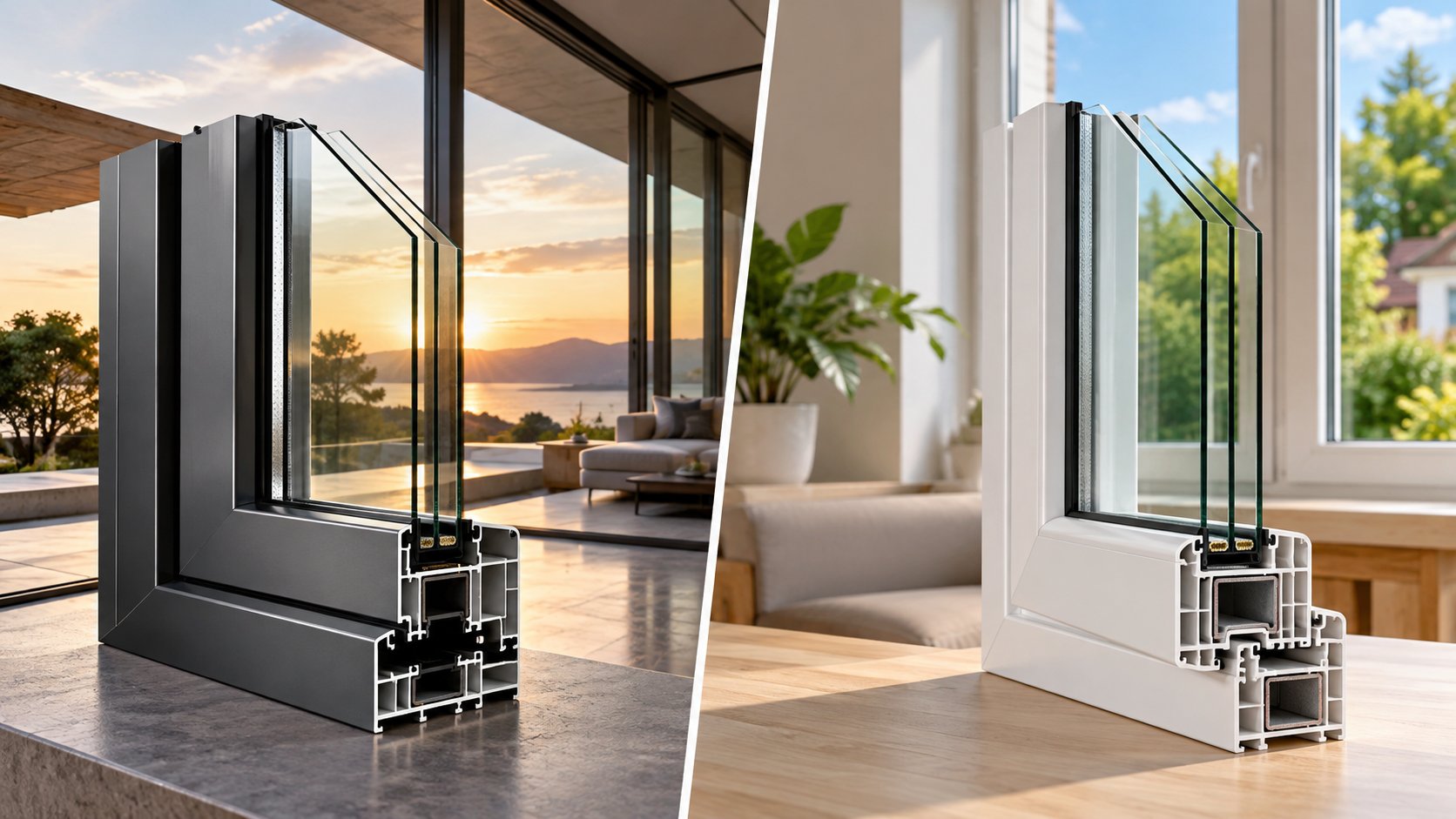
Aluminum vs PVC Windows: Which Is Better?
Aluminum or PVC? It’s a question that comes up in almost every window replacement project, and the answer isn’t always straightforward. The material you choose will affect your home’s insulation, the amount of maintenance you’ll need to do, and even how much glass you can fit into an opening.
Aluminum tends to be the stronger candidate for large windows, narrow frames, and modern architectural designs. PVC, often called vinyl in the United States, is usually less expensive and has a natural advantage when it comes to thermal insulation. But those differences only tell part of the story. A well-engineered aluminum window can outperform a poorly made PVC one, and the reverse is equally true.
So which makes more sense for your home or building? Let’s compare aluminum vs PVC windows in terms of cost, energy efficiency, durability, maintenance, climate conditions, and the types of projects where each material works best.
What Is the Difference Between Aluminum and PVC Windows?
The fundamental difference is the material used to manufacture the frame. Aluminum is a lightweight metal known for its strength and rigidity. PVC is a polymer with much lower thermal conductivity, meaning heat doesn’t pass through it as readily.
That distinction affects how manufacturers design the profiles, how large a window can be, and how the finished product handles temperature changes. Still, the frame is only one component. Glass, seals, hardware, drainage, and installation all contribute to the performance you’ll actually experience.
How Aluminum Window Frames Work
Aluminum window frames are made from extruded profiles. The manufacturing process allows the metal to be formed into precise shapes that accommodate glazing, seals, and opening mechanisms.
One of aluminum’s biggest advantages is its strength relative to its weight. Manufacturers can use comparatively slender profiles without sacrificing the structural support required for many large glazing applications. That’s particularly useful when you want expansive views and don’t want thick frames interrupting them.
Aluminum also offers considerable freedom in appearance. Powder coating and anodizing allow manufacturers to produce different colors, textures, and finishes for residential and commercial buildings.
There is a trade-off, though. Aluminum conducts heat readily. Without proper insulation, heat can travel through the frame and affect indoor comfort. This is why energy-efficient aluminum windows commonly use a thermal break, an insulating barrier that separates the interior and exterior metal sections.
How well that thermal break is designed makes a substantial difference to the finished window’s performance.
What Are PVC and uPVC Window Frames?
PVC stands for polyvinyl chloride. Window manufacturers generally use rigid, unplasticized PVC (uPVC), a formulation suited to producing stable structural profiles.
Unlike aluminum, PVC doesn’t conduct heat easily. Many PVC window frames also have several internal chambers that help reduce heat transfer. Depending on the window’s dimensions and structural requirements, manufacturers may add steel or other reinforcement inside the profiles.
You’ll often see the term “vinyl windows” in American product catalogs. It usually refers to window frames made from suitable PVC-based materials, although formulations and construction methods vary between manufacturers.
PVC windows have become a familiar choice in residential construction for understandable reasons: they generally cost less than aluminum alternatives, offer good insulation potential, and don’t demand much routine maintenance.
Aluminum vs PVC Windows: Key Differences at a Glance
Here’s how the two materials typically compare. These are general characteristics, not fixed performance ratings for every product on the market.
| Comparison Factor | Aluminum Windows | PVC/uPVC Windows |
|---|---|---|
| Initial Cost | Generally higher | Generally more affordable |
| Thermal Insulation | Can perform very well with effective thermal breaks | Usually good due to low material conductivity |
| Structural Strength | High strength and rigidity | Depends on profile design and reinforcement |
| Large Glass Openings | Particularly well suited | Possible within system limitations |
| Frame Appearance | Often slimmer and more minimalist | Typically thicker profiles |
| Maintenance | Low with appropriate finishes | Low with routine cleaning |
| Corrosion Resistance | Requires suitable finishes and compatible hardware | Does not rust |
| Color Options | Extensive finishing possibilities | Varies by manufacturer and profile system |
| Long-Term Value | Often attractive for demanding architectural applications | Often attractive for budget-conscious residential projects |
A premium PVC window may outperform an entry-level aluminum model in several areas. Likewise, a properly designed thermally broken aluminum system can deliver excellent insulation and weather resistance. Comparing actual product specifications is far more useful than judging the materials in isolation.
Aluminum vs PVC Windows: Pros and Cons
Neither material is without compromises. The advantages that make aluminum attractive for one building may be less relevant for another, particularly when budget or thermal performance takes priority.
Advantages and Disadvantages of Aluminum Windows
Aluminum’s greatest strength is quite literally its strength. It allows manufacturers to create rigid frames with relatively narrow visible profiles, making it especially appealing for buildings with large glass surfaces.
The main advantages include:
- High structural rigidity for demanding window configurations.
- Slim sightlines that suit contemporary architecture.
- Good suitability for large glass panels and sliding systems.
- A broad selection of powder-coated and anodized finishes.
- Relatively little routine maintenance when the finish is appropriate for the environment.
- The potential to recycle the frame material at the end of its service life.
Those benefits come with a few considerations. Aluminum without a thermal break transfers heat readily, which can increase energy losses and make condensation more likely in cold conditions. High-performance profiles with effective insulation barriers also tend to be more expensive than basic PVC systems.
Exposure matters as well. In coastal areas, the finish, fasteners, and other metal components need to be suitable for salt-laden air. Aluminum is durable, but that doesn’t mean every aluminum frame can be installed in every environment without additional consideration.
Advantages and Disadvantages of PVC Windows
PVC has a different set of strengths. For a homeowner replacing standard windows, the combination of insulation, price, and low maintenance can be hard to overlook.
Its advantages include:
- Good thermal insulation potential.
- Generally lower upfront costs.
- Minimal routine maintenance.
- Resistance to rust and many everyday environmental conditions.
- Compatibility with different glazing and profile configurations.
- Wide availability in common residential window sizes.
Where does PVC fall short? Larger openings may call for additional reinforcement, and some profile designs have wider visible frames than comparable aluminum systems.
PVC also expands and contracts with temperature changes. Manufacturers account for this during product design, but the material formulation, reinforcement, and installation details all affect how well a window maintains its shape over time. Prolonged sunlight exposure can influence appearance and durability, particularly in lower-quality products.
For standard residential windows, these limitations may never become a practical concern. For unusually large openings or demanding architectural designs, they’re worth examining before making a purchase.
Which Is More Energy Efficient: Aluminum or PVC Windows?
If you’re comparing the raw materials, PVC is the better insulator. Its thermal conductivity is substantially lower than aluminum’s.
But a window isn’t a solid piece of PVC or aluminum. Modern aluminum frames can incorporate sophisticated thermal breaks, while PVC windows vary considerably in profile construction, glazing, and airtightness. The finished assembly is what determines energy performance.
Thermal Insulation and U-Factor Comparison
The U-factor measures how quickly heat passes through a window. Lower values indicate better resistance to heat flow, an especially useful characteristic when you’re trying to reduce heating losses during winter.
PVC’s low conductivity gives it a natural starting advantage. Multi-chamber profiles can further limit heat transfer, although the actual improvement depends on how those chambers are designed.
Aluminum takes a different approach. A thermal break separates the interior and exterior aluminum sections, interrupting the path that heat would otherwise follow through the metal. Combined with appropriate glazing and seals, this allows certain aluminum windows to achieve performance ratings comparable to PVC alternatives.
When reviewing energy-efficient windows, look beyond the frame material and check:
- Whole-window U-factor, rather than a glass-only rating.
- Solar Heat Gain Coefficient (SHGC).
- Double or triple glazing specifications.
- Low-E glass coatings.
- Spacer design and edge-of-glass insulation.
- Air leakage ratings and weather seals.
These measurements don’t all describe the same thing. U-factor concerns heat transfer, while SHGC indicates how much solar heat enters through the window. A low SHGC may be desirable for a sun-exposed window in a hot climate, whereas cold-climate projects often place particular emphasis on reducing heat loss.
The right combination depends on the building, its orientation, and the local climate.
Condensation and Sound Insulation
Condensation isn’t simply an aluminum-window problem. It occurs when a surface becomes cold enough for moisture in the surrounding indoor air to condense on it.
Because untreated aluminum transfers heat so readily, non-thermally broken frames can develop cold interior surfaces during winter. Thermal breaks help address this. PVC’s insulating properties can also reduce the risk, although condensation may still appear around glass edges, spacers, or poorly installed components.
Indoor humidity and ventilation matter, too. Even a well-insulated window can develop condensation under unfavorable conditions.
Sound insulation deserves a separate look. It’s tempting to assume one frame material is automatically quieter, but glazing construction, glass thickness, laminated layers, cavity dimensions, and airtight seals often have a greater influence on acoustic performance.
If you live beside a busy road, ask for tested sound insulation ratings for the complete window assembly. A general claim that a frame is “soundproof” tells you very little.
Aluminum vs PVC Windows: Cost and Long-Term Value
For most buyers, price is unavoidable. Yet two windows that look similar in a quotation can differ substantially in glazing quality, hardware, insulation, and expected maintenance.
Which Window Material Is Cheaper?
PVC windows generally cost less than aluminum windows, especially when comparing standard residential models. Material costs, manufacturing methods, and profile complexity all contribute to the difference.
Thermally broken aluminum profiles involve additional engineering and components, which can push the price higher. Custom finishes and specialized opening mechanisms may increase it further.
Before comparing quotations, check whether you’re actually comparing equivalent products. Prices can change considerably depending on:
- Glazing type and energy performance.
- Frame dimensions and profile quality.
- Opening mechanisms and hardware.
- Security and weather resistance requirements.
- Custom colors and surface finishes.
- Installation complexity.
- Warranty coverage and local labor costs.
Consider a typical bedroom window. If the opening is a standard size and insulation is the priority, PVC may meet the requirements at a lower price. A large glazed opening in a contemporary home presents a different calculation: aluminum’s structural properties and slimmer profiles may justify the additional expense.
Neither example establishes a universal price rule. It simply shows why the intended application belongs in the comparison.
Maintenance, Lifespan and Replacement Costs
How long do aluminum and PVC windows last? There’s no single figure that applies to every manufacturer, climate, or installation.
Both can remain in service for decades when properly manufactured and maintained. What changes is the type of care they need and how environmental exposure affects individual components.
Aluminum frames should be cleaned periodically, with drainage channels kept clear and protective finishes inspected for damage. In coastal locations, maintenance may need to be more frequent because of salt exposure.
PVC frames also need cleaning, along with occasional checks of their seals, hinges, locks, and other moving parts. Although the frame itself won’t rust, metal reinforcement and hardware still need appropriate protection.
It’s also worth distinguishing frame lifespan from the lifespan of the complete window. A failed insulated glass unit or worn locking mechanism doesn’t necessarily mean the entire frame needs replacing.
For a realistic cost comparison, consider the purchase price, installation, possible energy savings, routine maintenance, and future repairs together. A lower initial price is useful, but it shouldn’t be the only number driving the decision.
Which Is Better for Different Climate Conditions?
A window that works beautifully in a mild climate may not be the best fit for a property facing freezing winters, intense sunlight, or coastal storms. Climate affects which performance characteristics deserve the most attention.
Aluminum vs PVC Windows in Cold Climates
In colder regions, the priority is usually to limit heat loss and keep interior surfaces reasonably warm.
PVC’s low thermal conductivity makes it a practical option for many homes. Aluminum can work just as effectively in suitable configurations, but a properly designed thermal break becomes particularly important.
Don’t rely on material descriptions alone. Compare whole-window U-factors, glazing specifications, and air leakage ratings. Poor installation can undermine the performance of either material, even when the window itself has excellent laboratory results.
Aluminum vs PVC Windows in Hot and Sunny Climates
Hot climates present a different challenge. Solar heat entering through the glass can increase cooling demand, while direct sunlight raises the temperature of exposed frames.
Aluminum windows can perform well in these conditions when the system includes suitable thermal breaks, finishes, and glazing. PVC also offers good insulation potential, but its thermal expansion characteristics and resistance to prolonged UV exposure deserve attention.
Frame color makes a difference. Dark surfaces can become considerably hotter in direct sunlight, so expansion allowances, finish quality, and installation details should be considered carefully.
For buildings where cooling is the main concern, SHGC and exterior shading may be just as relevant as the insulating properties of the frame.
Which Windows Are Better for Coastal Areas?
Living near the sea means dealing with salt, moisture, and often strong winds. These conditions affect much more than the visible frame.
PVC doesn’t rust, which is helpful in humid coastal environments. That advantage doesn’t extend automatically to its metal reinforcement, hinges, locks, or fasteners. Those components still need suitable corrosion protection.
Aluminum can be a reliable coastal choice as well, provided its surface treatment and associated hardware are specified for the exposure conditions. Compatible materials and appropriate maintenance are essential.
For coastal homes, we’d pay particular attention to tested wind resistance, water penetration performance, drainage design, protective finishes, and installation quality. Choosing a material without checking those details leaves too much to chance.
Aluminum vs PVC Windows for Modern Homes and Buildings
Sometimes the decision has less to do with insulation or price and more to do with what the architect wants the window to accomplish.
A small bathroom window and a floor-to-ceiling glazed opening have very different demands. Frame dimensions, glass weight, opening mechanisms, and structural loads can quickly become deciding factors.
Which Material Is Better for Large Windows and Sliding Doors?
Aluminum is often the stronger choice for large openings. Its rigidity allows manufacturers to design comparatively slender frames that can support substantial glazing, provided the complete system is engineered for the required dimensions and loads.
That combination is particularly attractive in modern homes where wide views and natural light are central to the design.
For projects that call for narrow sightlines or flexible architectural configurations, reviewing different aluminum window systems is a useful way to compare the available frame designs and opening options.
PVC isn’t excluded from larger windows. Reinforced PVC profiles can accommodate substantial glazing, but maximum sizes depend on the manufacturer’s engineering limits, reinforcement, glass weight, and the chosen opening mechanism.
For unusually wide or tall windows, those limitations should be checked against the project’s structural requirements before a material is selected.
Which Material Is Better for Residential and Commercial Projects?
In residential renovations, homeowners often want better insulation, manageable costs, and windows that don’t require constant attention. PVC can meet those priorities particularly well, especially for standard openings.
Comparing available PVC window systems can help clarify which profile configurations, glazing options, and installation requirements suit a particular home.
Commercial projects may have different priorities. Larger openings, heavier glazing, specialized finishes, and demanding hardware requirements can make aluminum an attractive material.
These aren’t rigid boundaries, however. PVC is used in commercial buildings, and aluminum is common in residential construction. The building’s specifications should determine the choice, not the label attached to the project.
Why TGP Systems Is Worth Considering for Window Projects
Material selection is only the beginning. A fixed panoramic window, an outward-opening casement window, and a wide sliding assembly may all use aluminum, yet each requires a different combination of profiles, glazing, seals, and hardware.
TGP Systems offers aluminum and PVC/uPVC window solutions, along with architectural glazing and sliding system options. Having different configurations available gives customers a way to compare products around the actual demands of their projects, whether those involve insulation, appearance, opening dimensions, or structural requirements.
Take a contemporary house designed around broad views of the outdoors. In that setting, aluminum sliding windows may be worth examining because of the material’s structural properties and the design possibilities of sliding configurations.
The final choice still depends on the specific system. Glazing weight, permitted dimensions, thermal performance, and installation conditions need to be checked before deciding whether a particular configuration is suitable.
That’s how we believe window comparisons should be approached: start with the building and its requirements, then identify the product characteristics that meet them.
How to Choose Between Aluminum and PVC Windows
If you’re still weighing the options, focus on the features you genuinely need. A window doesn’t have to be the strongest, most expensive, or most technically elaborate model available. It has to work for the building.
Choose Aluminum Windows If…
- You want large glass openings without unnecessarily wide visible frames.
- Your project features contemporary or minimalist architecture.
- Structural rigidity is a major design consideration.
- You need specialized sliding or architectural window configurations.
- You want access to extensive finishing and color options.
- Your budget allows for an appropriately specified thermally broken system where necessary.
Aluminum makes particular sense when structural performance and architectural flexibility are high priorities. Just make sure the selected system meets the thermal and weather resistance requirements of the building.
Choose PVC Windows If…
- You’re replacing standard residential windows.
- Keeping the initial purchase cost manageable matters.
- Thermal insulation is one of your main concerns.
- You prefer frames that need relatively little maintenance.
- Your openings don’t demand unusually large or complex structural configurations.
- You can find a tested PVC system that meets local building requirements.
For many conventional home renovation projects, PVC offers a sensible balance of insulation, cost, and everyday practicality. There’s little reason to pay for structural capabilities or architectural features your project doesn’t require.
What to Check Before Buying Windows
Before approving a quotation, ask for the specifications of the complete window rather than relying on the frame material alone.
- Thermal performance: Check the whole-window U-factor and relevant SHGC values.
- Weather resistance: Review documented air leakage, water penetration, and wind resistance performance.
- Glazing: Confirm glass thickness, coatings, safety requirements, and insulation specifications.
- Structural suitability: Verify permitted dimensions and loads for the proposed configuration.
- Hardware: Look at hinges, locks, rollers, handles, and the availability of replacement components.
- Installation: Make sure the installation method is appropriate for the wall construction and local conditions.
- Warranty: Check what is covered for profiles, finishes, glazing, hardware, and workmanship.
In the United States, NFRC ratings and applicable ENERGY STAR criteria can help you compare energy performance. Local building codes may impose additional requirements relating to structural loads, safety glazing, or impact resistance.
Ideally, compare windows designed to meet the same performance targets. Otherwise, a price comparison may tell you more about differences in product quality than about aluminum versus PVC.
Frequently Asked Questions About Aluminum vs PVC Windows
Are aluminum windows better than PVC windows?
Not necessarily. Aluminum is often the better fit for large openings, slim frames, and demanding architectural designs. PVC generally has an advantage in upfront cost and the insulating properties of the frame material. For a standard residential replacement, PVC may be entirely sufficient. For an expansive glazed opening, aluminum may offer more design flexibility. The complete system specifications ultimately matter more than the material name.
Are aluminum windows more expensive than PVC?
Yes, aluminum windows are generally more expensive, particularly when they include thermal breaks or specialized finishes. Actual prices vary with glazing, dimensions, hardware, and installation. A premium PVC window can still cost more than a basic aluminum model, so compare equivalent specifications rather than assuming the material alone determines the price.
Which lasts longer, aluminum or PVC windows?
Both can last for decades with proper manufacturing, installation, and maintenance. Aluminum offers high structural stability, while quality PVC resists many common environmental conditions. UV exposure, temperature changes, hardware quality, reinforcement, and maintenance all affect service life. It’s more useful to examine the quality and warranty of a particular product than rely on a universal lifespan estimate.
Are PVC windows more energy efficient than aluminum?
PVC is naturally a better insulator than aluminum, but that doesn’t guarantee better performance in every finished window. Thermally broken aluminum systems can achieve excellent energy ratings. Compare whole-window U-factor, SHGC, air leakage, and glazing specifications. Those measurements provide a much clearer picture of energy efficiency than frame material alone.
Do aluminum windows cause condensation?
They can, especially when the frames lack thermal breaks and outdoor temperatures are low. Condensation forms when an interior surface becomes cold enough for moisture in the air to collect on it. Thermal breaks and suitable glazing reduce the risk. Indoor humidity, ventilation, and installation quality also matter, and condensation can occur on PVC windows under unfavorable conditions.
Are aluminum windows better for large openings?
Often, yes. Aluminum’s strength and rigidity make it well suited to large glazed openings with relatively slim frames. PVC can also accommodate substantial windows when properly reinforced, but size limits depend on the profile and manufacturer. For large openings, confirm the permitted dimensions, glazing weight, and structural requirements of the specific system.
What is the difference between PVC, uPVC and vinyl windows?
PVC is the general term for polyvinyl chloride. uPVC refers to rigid, unplasticized PVC commonly used for window profiles. In the United States, these products are usually called vinyl windows. The terms overlap in everyday use, but manufacturers may use different formulations, reinforcement methods, and profile designs. Those differences can affect performance and durability.
Which window material is better for coastal homes?
Both can work well if specified correctly. PVC doesn’t rust, although its metal reinforcement and hardware still need corrosion protection. Aluminum requires suitable surface finishes, compatible fasteners, and appropriate maintenance for salt exposure. Coastal buyers should also examine tested wind resistance, water penetration performance, and installation details rather than focusing exclusively on frame material.
Are aluminum windows more secure than PVC windows?
Not automatically. Aluminum’s rigidity can be beneficial, but security also depends on locks, glazing, reinforcement, hardware, and installation. A properly designed PVC window with suitable security components may outperform a poorly specified aluminum one. Where security is a priority, ask for tested performance information for the complete window assembly.
Do PVC windows turn yellow over time?
Some older or lower-quality PVC formulations can discolor after prolonged sunlight exposure. Modern window-grade materials commonly include stabilizers intended to improve UV resistance and color retention. Results still vary by formulation, finish, and environmental conditions. Check the manufacturer’s specifications and warranty before choosing a particular frame color or product.
Can aluminum windows be as well insulated as PVC windows?
Yes. Certain thermally broken aluminum windows can achieve insulation ratings comparable to PVC systems. The thermal barrier, glazing, spacers, seals, and overall profile design determine the result. Don’t assume every aluminum window with a thermal break performs equally well, though. Compare documented whole-window ratings to see how individual products measure up.
Are aluminum or PVC windows easier to maintain?
Both are relatively easy to maintain. PVC generally needs routine cleaning and occasional checks of seals and hardware. Aluminum requires similar care, along with attention to protective finishes and drainage, especially in coastal or industrial environments. Hinges, locks, and glazing components may eventually need maintenance regardless of the frame material.
Which windows are better for modern house designs?
Aluminum is often favored for modern architecture because it allows slim profiles, broad glass surfaces, and varied finishes. PVC can also suit contemporary homes, particularly when its proportions and colors complement the building. If expansive views and minimal framing are central to the design, aluminum may offer greater flexibility. For more conventional openings, either material can work well.
Final Verdict: Should You Choose Aluminum or PVC Windows?
For large windows, slim frames, and projects with demanding structural or architectural requirements, aluminum is often the stronger candidate. PVC makes a compelling case for standard residential windows where insulation, purchase price, and low maintenance are the main priorities.
That doesn’t mean you should automatically choose PVC for energy efficiency or aluminum for durability. A thermally broken aluminum window can deliver excellent insulation, and a well-engineered PVC system can provide reliable long-term performance.
Start with the dimensions of your openings, the climate, and what you expect from the windows. Then compare glazing, thermal ratings, weather resistance, hardware, and installation requirements. You’ll get a much clearer answer than you would from material comparisons alone.
Find the Right Window System for Your Project
TGP Systems offers aluminum and PVC/uPVC window solutions for different architectural and performance requirements. If you’re planning a home renovation, new construction, or commercial project, exploring the available configurations can help you narrow down the options. You can also contact the team to discuss opening dimensions, design preferences, and technical specifications before making a decision.
Still deciding between aluminum and PVC? Share this guide with someone planning a window project, and tell us in the comments what matters most to you: insulation, appearance, durability, or cost.




Leave a Reply
You must be logged in to post a comment.