
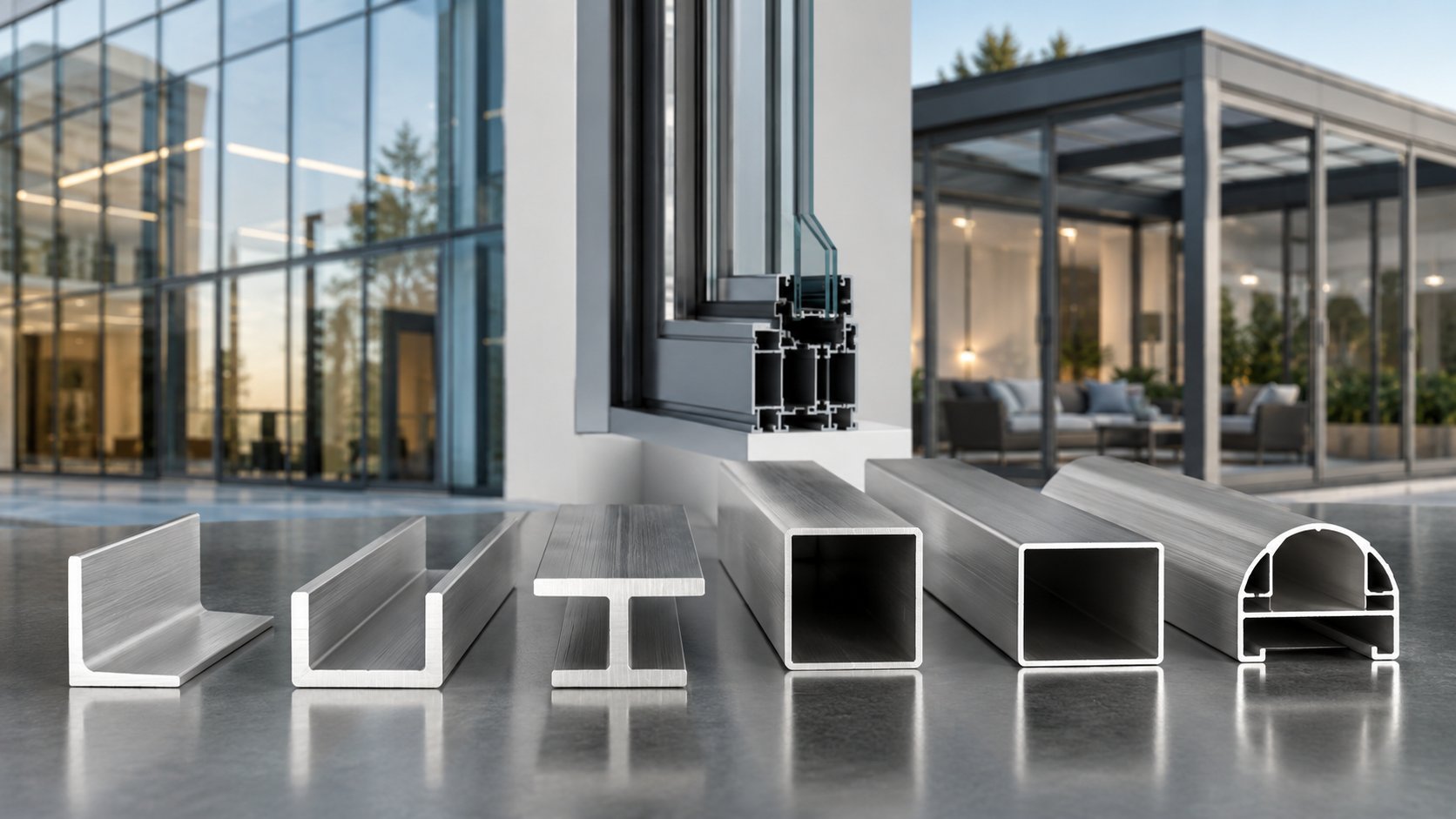
Aluminum Extrusion Profiles: Types and Applications
Aluminum extrusion profiles are long components with a consistent cross-section, produced by forcing a heated aluminum billet through a specially shaped die. This manufacturing method makes it possible to create simple bars, hollow tubes, detailed window frames, modular machine structures, and many other functional shapes from the same basic material.
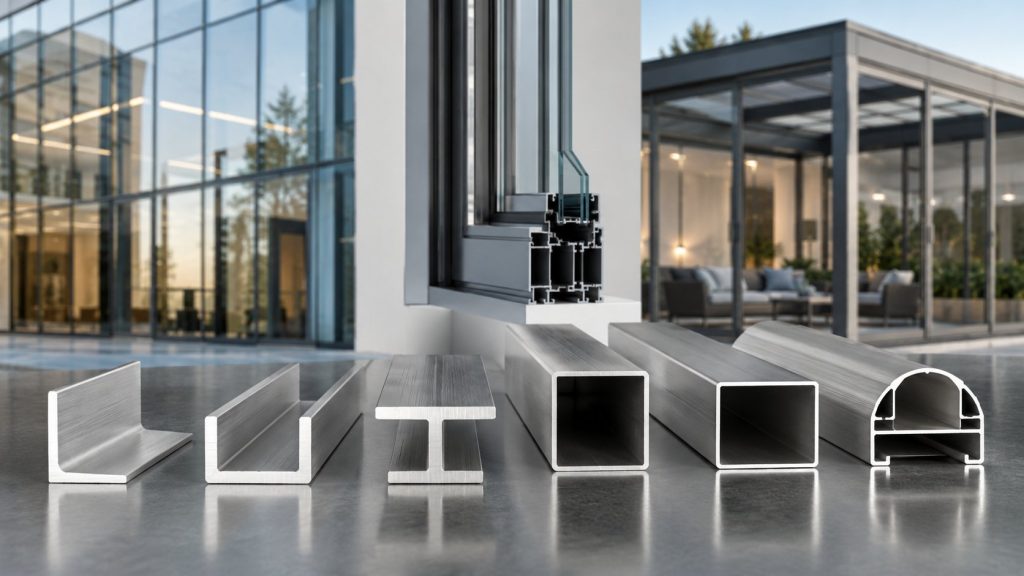
The real value of extrusion is not simply that it changes the shape of aluminum. A well-designed profile can include glazing channels, screw ports, drainage paths, gasket seats, reinforcement zones, and hardware interfaces within a single section. In practical terms, this can reduce the number of separate parts required in a finished product.
In this guide, we examine the main types of aluminum extrusion profiles, common profile shapes, alloys, surface finishes, industrial applications, and the technical criteria that should influence profile selection.
What Are Aluminum Extrusion Profiles?
Aluminum extrusion profiles are continuous aluminum sections manufactured with the same shape along their entire length. The final geometry is determined by the opening in the extrusion die, which functions much like a highly engineered mold.
Unlike a part cut from a thick block of metal, an extruded profile is created close to its final cross-sectional form. This is one reason extrusion can be efficient for components that require channels, ribs, cavities, mounting surfaces, or other repeating details.
You may also see these products described as extruded aluminum profiles, aluminum sections, aluminum extrusions, or architectural aluminum profiles. Although the wording changes, the basic concept remains the same: a long, consistently shaped component designed for a particular structural, mechanical, or architectural purpose.
How the Aluminum Extrusion Process Works
The process begins with the selection of a suitable aluminum alloy and the design of the required cross-section. Engineers must consider wall thickness, corner radii, internal cavities, tolerances, surface appearance, and the way the finished component will connect to other parts.
An aluminum billet is then heated to a controlled temperature that makes the metal easier to shape without turning it into a liquid. The billet is placed inside an extrusion press and pushed through the die under substantial pressure.
As the material exits the die, it takes on the required profile shape. The new extrusion is cooled, stretched to improve straightness, heat-treated when necessary, and cut to the requested length.
Secondary operations may follow. These can include drilling, punching, CNC machining, milling, tapping, cutting, anodizing, powder coating, or adding protective packaging for visible architectural surfaces.
Direct vs. Indirect Aluminum Extrusion
Direct extrusion is the most familiar method. In this process, the billet is pushed toward a stationary die, and the aluminum flows in the same direction as the press ram.
Indirect extrusion uses a different arrangement in which the die moves toward the billet. Because there can be less friction between the billet and the container wall, the method may offer advantages for certain profile designs or production requirements.
For most buyers, the press configuration is not the first selection criterion. The more important questions concern the finished profile: Is the geometry correct? Are the dimensions consistent? Does the alloy suit the application? Can the profile be finished, fabricated, and assembled as required?
Main Types of Aluminum Extrusion Profiles
Aluminum extrusion profiles are generally classified as solid, hollow, or semi-hollow according to their cross-sectional geometry. These categories affect die design, production complexity, profile behavior, and the functions that can be incorporated into the section.
| Profile Type | Cross-Section | Main Advantages | Common Applications |
|---|---|---|---|
| Solid profile | No completely enclosed internal cavity | Relatively straightforward geometry and efficient structural forms | Angles, bars, rails, brackets, supports, and trims |
| Hollow profile | One or more fully enclosed cavities | Good stiffness-to-weight potential and space for functional channels | Tubes, window frames, door frames, beams, and structural sections |
| Semi-hollow profile | A cavity that is partially but not fully enclosed | Functional geometry without a completely closed void | Tracks, channels, frames, guides, and custom architectural profiles |
Solid Aluminum Profiles
A solid profile does not contain a completely enclosed void within its cross-section. Common examples include flat bars, angles, T-sections, Z-sections, rails, and several types of open channels.
The word “solid” can be slightly misleading. It does not necessarily mean that the profile is heavy, thick, or physically large. It simply describes the geometry of the section.
Solid aluminum profiles are frequently used for brackets, edge trims, supports, panel connections, furniture components, mounting rails, and structural details. Their comparatively open geometry can also make some machining and finishing operations easier.
Hollow Aluminum Profiles
Hollow aluminum profiles contain one or more completely enclosed cavities. Round tubes, square tubes, rectangular tubes, and many advanced window or door frame sections belong to this category.
A hollow cross-section can provide good bending stiffness without the weight of a fully solid section of similar external dimensions. This is valuable in structures where low mass and controlled deflection are both important.
Internal cavities may also serve functional purposes. Depending on the system, they can accommodate reinforcement, fasteners, thermal barriers, drainage routes, screw ports, or connection elements.
Hollow profiles generally require more complex die design than basic solid profiles. That additional complexity is justified when the cavity improves structural efficiency or integrates functions that would otherwise require separate components.
Semi-Hollow Aluminum Profiles
A semi-hollow profile partially surrounds a void but does not create a completely enclosed cavity. Tracks, guides, frames, and deeply recessed channel profiles often fall into this group.
The distinction between solid and semi-hollow is not always obvious from a quick visual inspection. Opening width, cavity depth, and the relationship between the surrounding walls can affect the technical classification.
For the buyer, classification is less important than performance. The profile still needs to satisfy dimensional, structural, fabrication, and assembly requirements, regardless of whether it is officially described as solid or semi-hollow.
Standard vs. Custom Aluminum Extrusions
Standard aluminum profiles are based on commonly available shapes such as angles, tubes, flat bars, channels, and T-slot framing sections. They usually involve lower initial costs, shorter procurement times, and fewer tooling requirements.
Custom aluminum extrusion profiles are designed around a specific product or system. A custom section can combine mounting points, reinforcement ribs, gasket grooves, drainage channels, and decorative surfaces in one profile.
That integration can simplify assembly and reduce the number of individual parts. However, custom extrusion normally requires die development, minimum production quantities, technical review, and a longer preparation period.
In our view, the right comparison is not “standard versus custom” in isolation. The sensible question is which option produces the best total project outcome after tooling, machining, assembly time, waste, logistics, and future replacement needs are considered.
Common Aluminum Profile Shapes and Configurations
The solid, hollow, and semi-hollow categories describe profile geometry at a broad level. Within those categories, aluminum extrusions can be produced in many recognizable shapes for structural, architectural, decorative, and mechanical applications.
Angle, Channel, T-Section, and Z-Section Profiles
L-shaped aluminum angles are commonly used for edge protection, framing, corner connections, panel supports, and finishing details. Equal angles have legs of similar dimensions, while unequal angles are selected when the two sides perform different functions.
U-channels and C-channels can hold panels, guide moving elements, protect edges, or form part of a lightweight frame. Their open shape allows components to be inserted from one side, which can be useful during assembly.
T-sections are often used to join surfaces, reinforce panel connections, or create dividing lines. Z-sections can provide offsets between two surfaces and are frequently useful in cladding, roofing, facade substructures, and layered assemblies.
Square, Rectangular, and Round Tubes
Square and rectangular tubes are widely used in frames, supports, enclosures, furniture, transport equipment, and fabricated structures. Their flat faces make them relatively straightforward to connect to plates, brackets, and other profiles.
Round aluminum tubes are common in railings, handles, furniture, decorative structures, transport equipment, and fluid or cable protection applications. Their shape can also be advantageous where smooth external lines are preferred.
It is important not to estimate load capacity from external dimensions alone. Wall thickness, alloy, temper, unsupported length, connection design, loading direction, and local reinforcement can substantially change performance.
T-Slot and Modular Framing Profiles
T-slot aluminum extrusion is designed with continuous external channels that accept special nuts, fasteners, brackets, and accessories. This makes it possible to assemble structures without welding.
These profiles are common in machine frames, safety guards, conveyor structures, assembly stations, laboratory equipment, automation cells, and modular partitions. Components can be repositioned or replaced without rebuilding the entire frame.
The practical advantage is flexibility. A production cell that changes every year may benefit more from an adjustable T-slot structure than from a permanently welded frame, even when the initial material cost is higher.
Thermal Break Profiles for Building Systems
Aluminum transfers heat efficiently, which is useful in heat sinks but can be a disadvantage in exterior windows, doors, and facade systems. A thermal break profile is designed to limit heat transfer between the internal and external aluminum sections.
The thermal barrier is only one part of the solution. Glass specification, frame geometry, gaskets, spacers, installation quality, air leakage, drainage, and the overall system design all influence thermal performance.
A hollow profile is not automatically a thermal break profile. Similarly, the presence of a thermal barrier does not guarantee a particular insulation value unless the complete system has been designed and assessed correctly.
Aluminum Alloys and Tempers Used in Extrusion
Profile geometry determines the shape of a component, while alloy and temper influence characteristics such as strength, formability, machinability, corrosion resistance, and surface quality. Selecting an alloy by name alone is rarely enough.
| Alloy | General Characteristics | Typical Uses |
|---|---|---|
| 6063 | Good extrudability, visible surface quality, and finishing response | Windows, doors, curtain walls, trims, and architectural profiles |
| 6061 | Good structural strength and machinability | Machinery, structural frames, transport, and fabricated parts |
| 6005 or 6005A | Balance of strength and extrusion capability | Structural and transport-related sections |
| 6082 | Suitable for higher-strength engineering applications | Load-bearing parts and fabricated structures |
| 1050 or 1070 | High electrical and thermal conductivity | Electrical and heat-transfer components |
| 3003 or 3103 | Good formability and corrosion resistance | Cladding, HVAC, and general fabrication |
| 5083 | Strong corrosion resistance in demanding environments | Marine and offshore applications |
6063 Aluminum for Architectural Profiles
6063 aluminum is commonly associated with visible architectural extrusions. It can be suitable for detailed sections used in window frames, door frames, curtain walls, trims, glazing systems, and decorative applications.
Its popularity is linked to extrudability and surface appearance, particularly when a clean anodized or coated finish is required. Complex profile geometry can often be produced with relatively good visual consistency.
Still, the alloy designation should not be treated as a quality certificate on its own. Temper, wall thickness, die quality, dimensional control, surface preparation, and finishing conditions remain important.
6061 Aluminum for Structural Components
6061 is widely considered for structural and engineering parts that require a useful balance of strength, corrosion resistance, machinability, and fabrication capability. Typical applications include machine frames, transport components, brackets, marine parts, and engineered structures.
It may also be selected when profiles require substantial machining, drilling, or welding after extrusion. That does not mean 6061 is automatically the superior choice for every application.
For a visible architectural frame with a highly detailed cross-section, 6063 may offer a more suitable combination of extrusion behavior and surface quality. The correct alloy depends on the actual priorities of the finished component.
Understanding Aluminum Tempers
Temper describes the mechanical condition of the aluminum after processes such as cooling, aging, strain hardening, or heat treatment. Two profiles made from the same alloy can perform differently when supplied in different tempers.
T5 generally indicates that the product has been cooled after shaping and then artificially aged. T6 normally involves solution heat treatment followed by artificial aging.
Specifications should therefore identify both alloy and temper when mechanical properties are important. Writing only “6063 aluminum,” for example, may leave essential performance information undefined.
Surface Finishes for Extruded Aluminum Profiles
Surface treatment affects much more than color. It can influence corrosion protection, appearance, cleaning requirements, resistance to weathering, and the way a profile fits into the visual identity of a building or manufactured product.
Anodized Aluminum Profiles
Anodizing creates a controlled oxide layer on the aluminum surface. The treatment retains the metallic character of the material while improving surface durability and corrosion resistance under suitable conditions.
Anodized profiles are frequently used in windows, doors, facade details, interior architecture, furniture, and decorative applications. Natural metallic tones are common, although other shades may also be available.
The final appearance can be influenced by alloy composition, surface preparation, extrusion quality, and processing conditions. For this reason, visible profiles from different production batches may require careful color control.
Powder-Coated Aluminum Profiles
Powder coating offers a broad choice of colors, textures, and gloss levels. It is widely used for architectural profiles where the frames must match a facade, interior design concept, corporate identity, or surrounding building elements.
Reliable coating performance depends on correct pretreatment, suitable powder selection, controlled film thickness, and proper curing. A visually attractive finish is not enough if the preparation beneath it is inadequate.
For exterior applications, exposure conditions should be considered before the finish is specified. Coastal air, industrial pollution, strong sunlight, and cleaning chemicals can all influence long-term performance.
Painted, PVDF, and Decorative Finishes
Liquid paint systems and PVDF coatings may be specified for certain architectural or industrial environments. These options can provide particular color, durability, or appearance characteristics when applied through a controlled process.
Decorative finishes may include brushed, polished, wood-effect, textured, or patterned surfaces. Such treatments can help aluminum profiles resemble other materials while retaining the dimensional advantages of extrusion.
There is no universal finish for every project. Honestly, the best choice often becomes clear only after the environment, maintenance plan, visual expectations, production quantity, and budget are considered together.
Aluminum Extrusion Profile Applications by Industry
Aluminum extrusion applications extend from residential windows to factory automation and electric vehicles. The same manufacturing principle can produce a narrow decorative trim, a complex thermally broken frame, or a substantial structural section.
Windows, Doors, and Sliding Systems
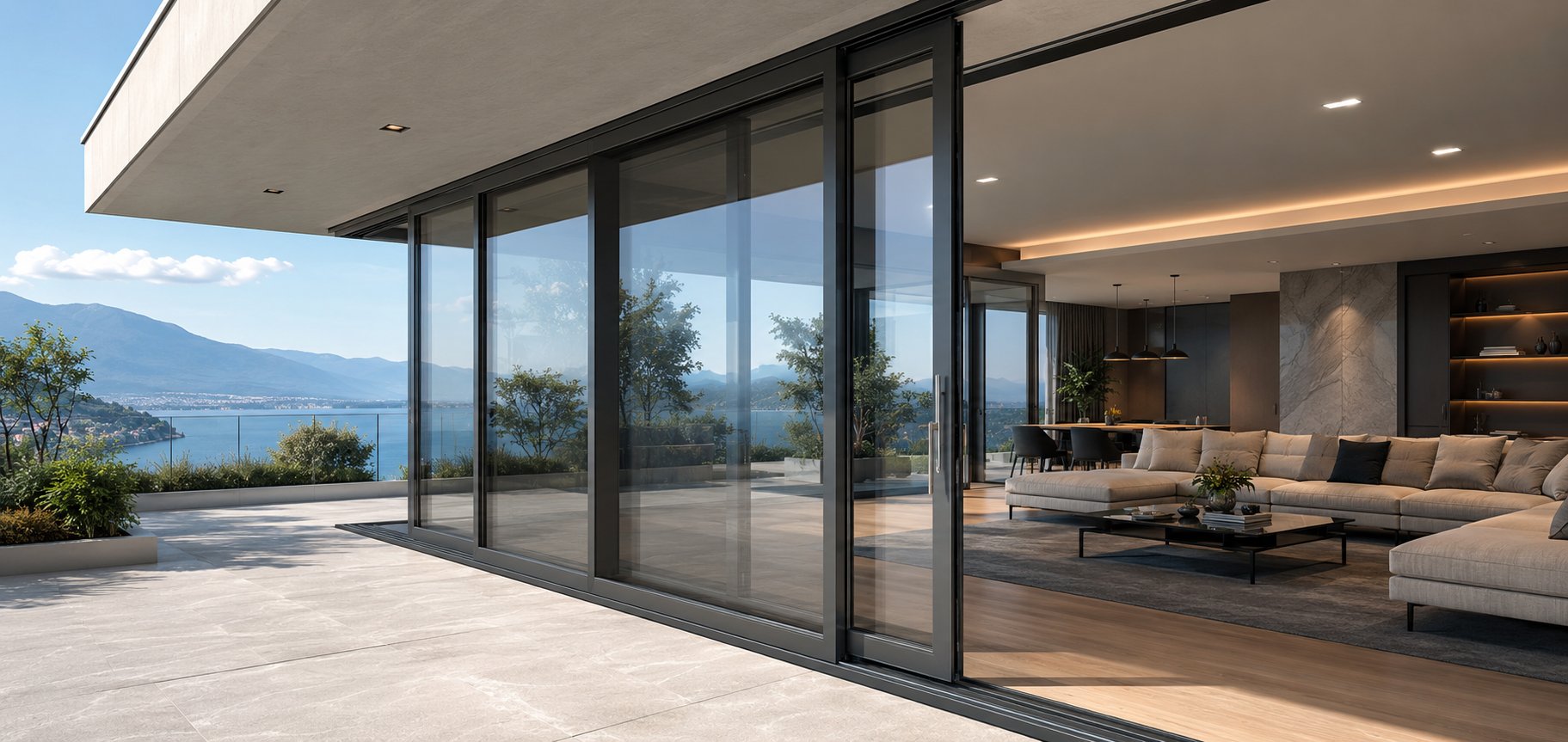
Window and door profiles are among the clearest examples of what extrusion can achieve. A single cross-section may include glazing pockets, gasket channels, drainage paths, roller tracks, hardware interfaces, reinforcement zones, and interlocking details.
Sliding systems require particular attention because the profile and the movement components work together. Panel weight, roller capacity, track alignment, glass thickness, frame rigidity, drainage, and locking geometry must be coordinated.
Casement, tilt-and-turn, lift-and-slide, fixed, and folding systems each demand different profile arrangements. Two products may look similar from a distance while behaving very differently under wind, water, repeated operation, or heavy glass loads.
Facades, Curtain Walls, and Exterior Cladding
Facade profiles can form mullions, transoms, pressure plates, cover caps, panel supports, glazing retainers, and substructure connections. These components must accommodate wind pressure, building movement, drainage, expansion, installation tolerances, and the weight of glass or cladding panels.
Extruded sections are also used behind decorative exterior surfaces, where they create alignment and attachment points for panels. Properly designed aluminium facade cladding systems can combine lightweight substructures with clean architectural detailing.
Facade design should always be approached as a complete assembly rather than a collection of isolated profiles. Connections, anchors, sealants, membranes, drainage zones, panels, and installation workmanship all contribute to final performance.
Glazing, Railings, and Outdoor Enclosures
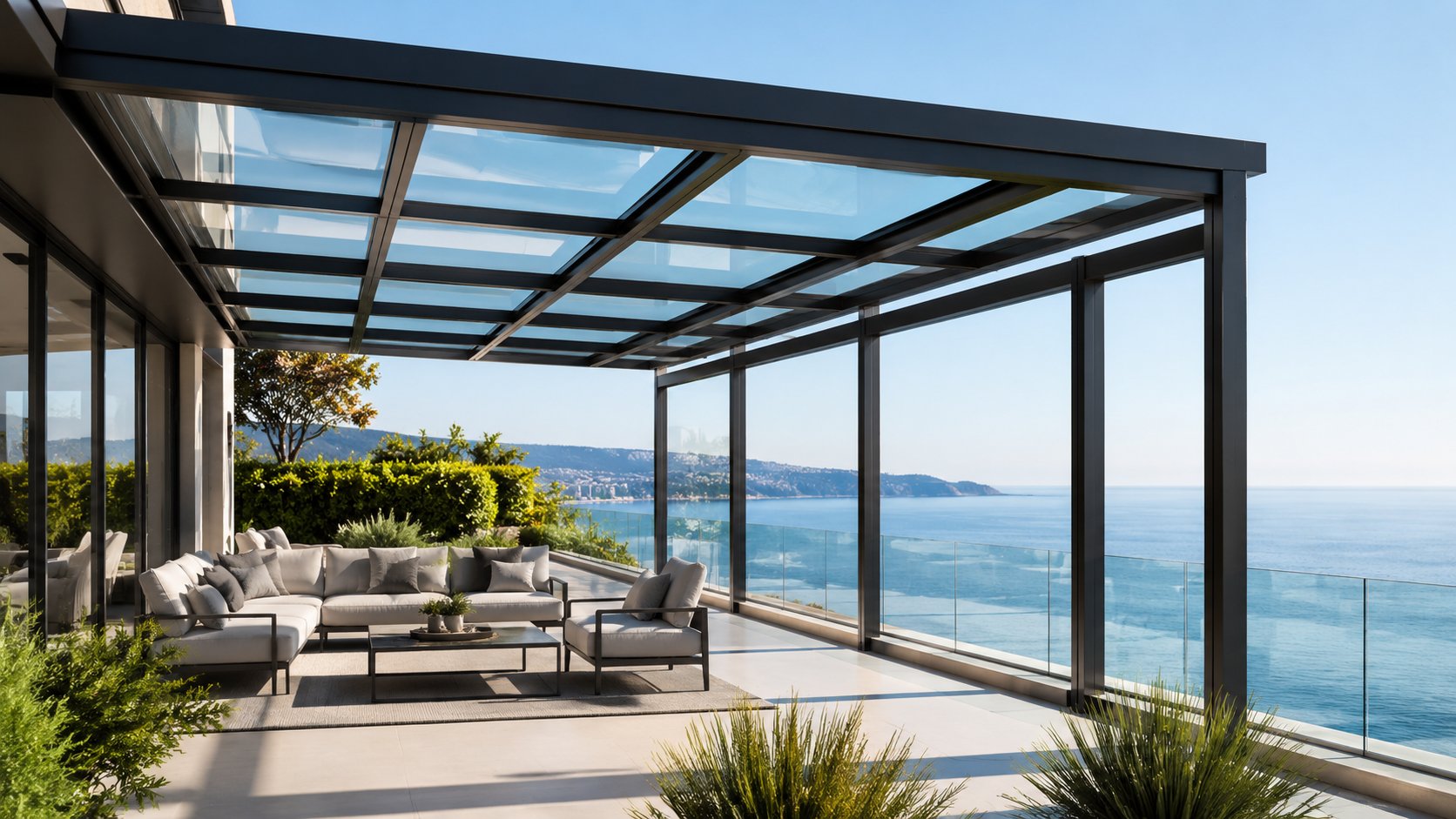
Aluminum profiles are widely used in glass channels, railings, balustrades, patio enclosures, balcony enclosures, pergolas, and winter garden structures. Their low weight, corrosion resistance, and finishing flexibility suit both residential and commercial environments.
Outdoor applications introduce practical challenges. Water needs a clear escape path, coatings must suit the exposure level, dissimilar metals may require separation, and fasteners must be selected for the actual environment.
We often see projects focus heavily on the visible profile while underestimating brackets, gaskets, anchors, and drainage details. Yet those less noticeable parts frequently determine whether the system remains stable and serviceable after years of weather exposure.
Industrial Machinery and Automation
Industrial aluminum profiles can form machine frames, safety guards, conveyor supports, assembly benches, enclosures, inspection stations, and robotic cells. Modular systems are particularly helpful when production layouts change regularly.
Profiles can be cut, drilled, tapped, and connected with standardized brackets. This allows technicians to replace one section or reposition equipment without cutting apart a welded frame.
For high-vibration or heavily loaded equipment, connection stiffness still requires careful evaluation. Modularity is useful, but it does not remove the need for proper engineering.
Automotive, Rail, and Transportation
Transportation applications use extruded aluminum in vehicle structures, rail interiors, roof rails, battery housings, impact-management components, flooring sections, and body assemblies. Reducing mass can support efficiency, payload, or range targets.
Complex hollow profiles may integrate reinforcement zones and connection points while limiting the number of welded parts. This can improve manufacturing efficiency when production volumes justify specialized tooling.
Weight reduction alone should not be treated as the final objective. Crash performance, fatigue, joining methods, corrosion exposure, repairability, and production consistency must also be considered.
Electronics, Solar, and Thermal Management
Aluminum’s thermal conductivity makes extrusion useful for heat sinks, LED housings, power electronics, electrical enclosures, and battery-management components. Fins and channels can be incorporated directly into the profile to increase surface area.
Solar applications include panel frames, mounting rails, support profiles, inverter housings, and cable-management elements. Low weight helps reduce handling demands during transport and installation.
This sector also demonstrates an interesting contrast. High thermal conductivity is an advantage for cooling electronics, while the same property creates a need for thermal separation in exterior building frames.
Furniture and Interior Architecture
Interior applications include partition systems, shelving, display units, cabinet frames, office furniture, lighting tracks, wall trims, and decorative screens. Aluminum provides straight lines, repeatable dimensions, and a wide choice of finishes.
Channels for panels, lighting, fasteners, and concealed connections can be incorporated into the extrusion. This helps designers achieve a clean appearance without relying on numerous visible brackets.
Advantages and Limitations of Aluminum Extrusion Profiles
Aluminum extrusion offers major design advantages, but no material or production method is ideal in every situation. A reliable specification should acknowledge both strengths and constraints.
Key Advantages
- Useful strength-to-weight potential: Aluminum profiles can deliver structural stiffness with less mass than many solid alternatives.
- Complex cross-sections: Channels, ribs, cavities, and connection details can be integrated into one continuous part.
- Corrosion resistance: Aluminum performs well in many environments when the alloy, finish, and connections are selected correctly.
- Machinability: Profiles can be cut, drilled, milled, tapped, and fabricated after extrusion.
- Finish flexibility: Anodizing, powder coating, painting, polishing, and decorative treatments provide many appearance options.
- Dimensional consistency: A controlled extrusion process can produce repeatable cross-sectional geometry over long lengths.
- Recyclability: Aluminum can be recovered and recycled, although the environmental performance of a product still depends on sourcing, manufacturing, service life, and end-of-life handling.
- Part consolidation: A custom profile can sometimes replace several brackets, channels, and covers with one engineered section.
Important Limitations and Design Considerations
Aluminum transfers heat readily, so exterior building profiles may require thermal separation. This is particularly important where energy performance, condensation control, and interior surface temperatures are critical.
Custom profiles involve tooling costs and minimum order requirements. A highly specialized die may not be economically sensible for a small, one-time project.
Thin walls and deep cavities can create challenges related to tolerances, twisting, surface lines, and extrusion consistency. Profile design should therefore be reviewed with realistic manufacturing limitations in mind.
Galvanic corrosion can occur when aluminum is connected to incompatible metals in the presence of moisture. Appropriate fasteners, coatings, separators, and drainage details may be required.
Packaging also deserves attention. A technically perfect architectural profile can lose value quickly if visible surfaces are scratched during handling, machining, transport, or site storage.
How to Choose the Right Aluminum Extrusion Profile
The right aluminum profile is the one that meets the complete application requirement, not simply the section that looks closest to a drawing. Selection should begin with function and performance before moving to appearance and price.
Define the Application and Structural Requirements
Start by identifying what the profile must do. Will it carry glass, support a panel, guide a moving sash, form a machine frame, protect an edge, or connect two structural elements?
Record the expected loads, unsupported length, opening dimensions, movement frequency, vibration, impact risk, indoor or outdoor exposure, and required service life. A profile that works in a small fixed frame may not be appropriate for a wide moving panel.
Visible architectural profiles also require attention to sightlines, joint alignment, drainage, coating quality, corner connections, and consistency between production batches.
Match the Alloy and Temper to the Environment
Consider strength, machinability, weldability, formability, corrosion exposure, and finish requirements. A marine environment, an indoor automation frame, and a powder-coated residential window do not place the same demands on the material.
The specified alloy should also be compatible with later fabrication. Extensive machining, bending, welding, anodizing, or coating may influence the preferred material condition.
Evaluate Profile Geometry and Tolerances
Review overall dimensions, wall thickness, corner radii, straightness, twist, flatness, cut length, and critical interface measurements. Not every dimension requires the same tolerance.
Tight control should be concentrated where the profile connects to glass, gaskets, rollers, locks, hinges, adjacent profiles, or automated equipment. Applying unnecessarily strict tolerances everywhere can increase cost without improving the finished product.
Coordinate the Profile With Glass, Seals, and Hardware
Profiles in windows, doors, facades, and enclosure systems cannot be selected independently from the components they support. Glass thickness, gasket compression, roller capacity, drainage parts, locks, handles, fasteners, and thermal barriers must fit the intended section.
Before fabrication begins, designers should confirm compatibility with the required hardware for aluminium windows and doors. A small mismatch in a groove or mounting interface can create larger assembly problems later.
This system-level approach is especially important for moving panels. Smooth operation depends on the relationship between profile alignment, panel weight, rollers, tracks, locks, and installation accuracy.
Compare Standard and Custom Profiles by Total Project Cost
Price per meter or price per kilogram provides only part of the picture. Tooling, machining, cutting, finishing, assembly labor, waste, packaging, delivery, and installation all affect total cost.
A standard profile may be less expensive to purchase but require several additional brackets and machining steps. A custom profile may cost more initially while reducing assembly time and part count.
Replacement availability also matters. For long-life building systems, access to compatible profiles and hardware years after installation can be more valuable than a small saving at the beginning.
Questions to Ask an Aluminum System Supplier
- Which alloy and temper are recommended for this application?
- What dimensional tolerances can be maintained consistently?
- Which surface finishes are suitable for the exposure conditions?
- Can the profile accommodate the required glass, seals, and hardware?
- Are cutting, drilling, milling, or other fabrication services available?
- What are the minimum order quantity and expected lead time?
- Which inspection or quality-control documents can be supplied?
- How are visible surfaces protected during production and transport?
- Is technical support available during profile or system selection?
- Can compatible accessories and replacement components be sourced later?
Why Choose TGP Systems for Aluminum Building Solutions?
Choosing an aluminum solution involves more than finding a profile with the right outer dimensions. Profiles, glazing, seals, hardware, locking components, and movement mechanisms must work together as one coordinated system.
TGP Systems supports this practical approach with a broad portfolio for residential and commercial building projects. Its product range includes aluminum windows and doors, sliding solutions, outdoor enclosures, facade-related systems, glazing products, railings, and compatible hardware components.
This breadth can make project planning more straightforward. Instead of evaluating each component in isolation, architects, fabricators, installers, and buyers can consider how the principal parts of the system will interact.
Product quality is only one part of supplier selection. Competitive pricing, responsive communication, delivery capability, technical guidance, service standards, and warranty support also influence the real value of a project partnership. TGP Systems brings these criteria together for customers seeking dependable building-system solutions rather than disconnected individual parts.
Frequently Asked Questions About Aluminum Extrusion Profiles
What are the three main types of aluminum extrusion profiles?
The three main types are solid, hollow, and semi-hollow profiles. Solid profiles have no fully enclosed cavity, hollow profiles contain one or more enclosed voids, and semi-hollow profiles partially surround a cavity without closing it completely.
What is the difference between aluminum extrusion and an aluminum profile?
Aluminum extrusion describes the manufacturing process, while an aluminum profile is the shaped product created through that process. In everyday industry language, however, “aluminum extrusion” is also commonly used to refer to the finished profile itself.
What is the difference between 6061 and 6063 aluminum?
6061 is commonly selected for structural, machined, or fabricated components that require higher mechanical performance. 6063 is widely used for architectural profiles because it combines good extrudability with an attractive finished surface. The correct choice depends on geometry, temper, exposure, fabrication, and performance requirements.
What are aluminum extrusion profiles used for?
They are used in windows, doors, facades, curtain walls, patio enclosures, machinery, automation frames, vehicles, rail systems, electronics, solar-panel frames, furniture, partitions, railings, and many other products that require lightweight, repeatable cross-sections.
Are aluminum extrusion profiles suitable for outdoor use?
Yes, aluminum profiles can be suitable for outdoor use when the alloy, surface finish, fasteners, drainage design, and installation method match the environment. Coastal, industrial, or highly exposed locations may require more careful corrosion protection and maintenance planning.
What is a custom aluminum extrusion profile?
A custom aluminum extrusion profile is manufactured from a die created for a specific product or project. It can integrate channels, ribs, cavities, mounting points, drainage routes, and decorative surfaces that are not available in standard profiles.
Are hollow aluminum profiles stronger than solid profiles?
Not automatically. Hollow sections can provide an efficient stiffness-to-weight ratio, but actual capacity depends on external dimensions, wall thickness, alloy, temper, unsupported length, connections, and the direction and type of load.
Which aluminum profile is best for windows and doors?
There is no universal profile for every window or door. Selection depends on opening type, frame dimensions, panel weight, glass thickness, wind exposure, drainage, thermal requirements, hardware, security, and applicable building standards.
What is a thermal break aluminum profile?
A thermal break profile uses a low-conductivity barrier to reduce heat transfer between the indoor and outdoor aluminum sections. It is commonly used in exterior windows, doors, and facade systems where thermal performance and condensation control are important.
Can aluminum extrusion profiles be welded?
Many aluminum extrusion alloys can be welded, but weldability varies by alloy and temper. Welding can also affect local mechanical properties, dimensions, appearance, and heat-treatment condition, so the complete fabrication process should be reviewed before production.
Can aluminum profiles be recycled?
Yes, aluminum can be recycled and returned to productive use. The overall environmental impact of a profile still depends on recycled content, energy sources, manufacturing efficiency, service life, transport, maintenance, and proper recovery at the end of use.
How are aluminum extrusion profiles joined?
Profiles can be joined with screws, bolts, brackets, corner cleats, T-slot fasteners, rivets, adhesives, welding, crimping, or specialized mechanical connectors. The preferred method depends on load, access, appearance, disassembly needs, and the profile geometry.
How do I select an aluminum extrusion supplier?
Compare technical support, alloy and temper options, dimensional control, finishing quality, fabrication capability, component compatibility, lead times, packaging, pricing, warranty support, and replacement-part availability. A supplier that understands the complete system can often prevent costly interface problems.
Why do aluminum profiles have internal channels and ribs?
Internal channels and ribs can increase stiffness, guide fasteners, support gaskets, provide drainage, hold reinforcement, locate hardware, or simplify assembly. Their purpose should be linked to the product’s function rather than added merely to make the section look more complex.
How much do custom aluminum extrusion profiles cost?
Cost depends on profile weight, alloy, die complexity, order quantity, tolerances, finishing, fabrication, packaging, and transport. Custom profiles normally require an initial tooling investment, but they may reduce total project cost by combining several functions into one component.
Find the Right Aluminum System for Your Project
The most suitable profile must work with the glass, seals, hardware, finish, operating mechanism, and installation conditions of the project. Explore TGP Systems’ aluminum sliding window systems to see how engineered profiles and compatible components come together in a complete architectural solution.
Share your project type, opening dimensions, panel weight, performance expectations, preferred finish, location, and delivery requirements with the TGP Systems team to request a tailored recommendation and quotation.
Found this guide useful? Share it with your project team and leave a comment about the aluminum profile questions you encounter most often.



Leave a Reply
You must be logged in to post a comment.